
Concept and Overview
Concept:
My project is called Uni Adl Threads, and the concept is inspired by established Street Style photography blogs, but my project is focused solely on student style seen on the University of Adelaide campus.


Target audience characteristics:
– Adelaide University students – my audience are University of Adelaide students studying at the North Terrace campus. The majority of the audience would be between 18-26, but would include all age students.
– Interest in style and popular culture – my audience does not need to be interested in ‘fashion’ – i.e. designer brands, fashion trends, etc – but they are interested in the way people express their identities through their personal style. Hence the focus and use of the word ‘style’ instead of ‘fashion’.
– Interest in social aspect of uni – my audience is interested in being part of the university social community. The project is aimed to be used as a community building tool, where the audience would recognise fellow students, their friends or even themselves, and can be a talking point between students.
– Progressive ideology – my audience is positively geared towards diverse representation, and interested in expressions of individuality. Racial and body diversity, gender non-conformity, and general eccentricity or zaniness will be positively viewed.
Differences between Uni Adl Threads and similar sites:
My project is highly localised to just the University campus, as opposed to many other street style blogs, which are not only based overseas from Australia, but also often post photos from various cities around the world. It also features recognisable subjects; fellow students that the audience may either know personally or recognise from around campus, as opposed to other street style blogs where the subjects are mainly anonymous to the audience. In these ways, the project is relatable to the audience, as opposed to other street style blogs that have an overall glamour and unattainability.


Visual Communication and Design

Photography:
As photographs are the main content of the project, I focused on taking very high-quality photographs. For this used a Canon 50D camera, mostly with a 50mm lens. To allow the audience to focus on the style of the subject, I kept the composition simple, generally a full-length straight on portrait. When the subject was amenable to it, I took additional angles and slightly closer up photos, to compliment the main full-length photo. I used a wide aperture to create a slightly blurred background and make the subject stand out. Editing was kept to minimal adjustments in exposure and saturation.
As mentioned, this is really the core of the project, so it was essential that the photographs were good quality and enjoyable for the audience to view.
Branding Design:
For my branding, my intention was to make it memorable and recognisable, to stand out amongst all the other ‘clean, simple’ websites and of course on social media platforms where the main structure of all pages is identical.
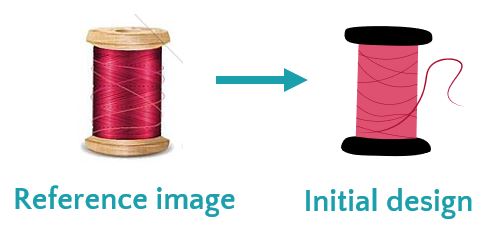
I created a logo of a thread bobbin; this ties into not only the Thread part of the project name (which is a colloquial term for clothes) but also to the process of making clothes by sewing with thread. In this way, the logo is iconic (“Icon/iconic: a mode in which the signifier is perceived as resembling or imitating the signified; recognisably looking, sounding, feeling, tasting or smelling like it” Hobbs 2012, p.90) which may help the audience with recalling the name of the project.
I went with some bright, bold colours for a sense of fun and energy. I have created alternate versions of the logo in different colours for the different platforms, and used them to create my WordPress header.


User Interface Design
Because I envisage the main platform of the project to be Instagram, the wordpress site is a secondary, supporting platform. Here the images can be viewed larger to see in more detail. It also serves the purpose of being a good professional looking site to display my photography for portfolio purposes.

For both these purposes, the images are displayed simply and efficiently. I have used a traditional single column blog layout, to display the photos in chronological order (newest on top).
The interface is straight forward, with just one main menu displayed underneath the header at the top of every page. After the Home button, there is an About Me page that gives a tiny bit of information about myself. After that, there is an Archive menu, where the posts from specific previous months can be viewed. Following that are links to the project accounts on Twitter and Instagram.
User Experience Design across Digital Platforms
Twitter:
I have used Twitter mainly to promote new posts and refer the audience to view the posts on either wordpress or Instagram. I also engage a bit with fellow DigiPlat students.
Instagram:
Instagram is the main platform for my project, and this is where I intend for my audience to mainly access the content. I believe Instagram suits the project because it is almost wholly image based, and I want people to be able to access it as part of their normal activities rather than having to go to a specific website to see the content.
I have used the Uni Adl Threads logo as the profile picture to tie it into the project branding.
I post all of the project photographic content here, with one subject/outfit per post. In the post descriptions I list the subject’s first name and their study degree. I also tag accounts and use hashtags that relate to the University of Adelaide (such as @uniofadelaide and @adelaideuniversityunion, #uniofadelaide, #adelaideuniversity) and popular hashtags relating to street style and fashion (#campusfashion, #streetstyle, #outfitoftheday, etc).
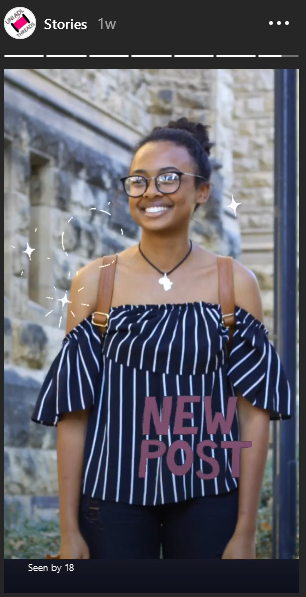
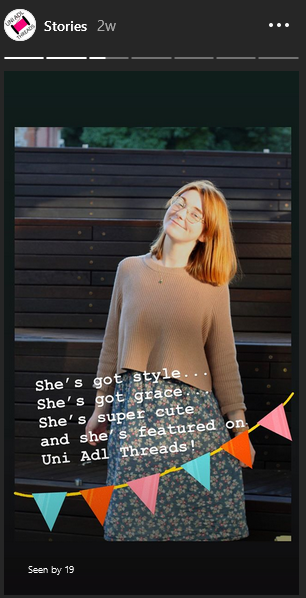
I also use the Instagram Stories to promote new posts, using the photo from the new post with fun, informal text and stickers.
Audience Metrics
WordPress:
The website overall has had 101 views, from 45 visitors. 92 of the views have been from Australia, this is good because my target audience are local students. The most refers have come from the WordPress Reader with 18, followed by twitter with 13, Instagram with 10, and Facebook with 1. I am not sure how the facebook refer has come about, since the project does not have a facebook account and I have not posted about it on my personal facebook account. The most popular page with 71 views is the home page, this is good because all the content can be viewed here in blog format.
Twitter:
May was the month with the most tweet impressions with 2,581, correspondingly it was also the month with the most tweets, with 10 tweets including replies to other DigiPlat users’ tweets. My tweet with the highest impressions and engagement rate was the Henlo tweet, but other then that my tweets with the highest impressions are the ones where I have used multiple hashtags and @s, relating to both the University and style/fashion.
Instagram:
Overall stats: 15 posts, 53 followers, average likes per post 20. From my own quick analysis, the 53 followers fall into three categories; fellow DigiPlat students, my family and friends, or very random accounts that don’t appear to have any relation to Uni of Adelaide, so I need to work on connecting better with my target audience.
Future Directions and Development
Moving forward, if I continued my project I would have two main aims; to have consistent posts, ideally daily, and to increase my connection to my target audience. Some of my ideas for increasing my audience would be to also set up a facebook account for the project, tag my subject’s social media accounts on the posts, and to reach out to other university accounts with large student followings and ask them to feature my account.
As to whether I will actually continue the project, I am still considering this. There has recently been a new uni club called Adelaide Fashion Collective set up, and one of the aspects of the club will be to feature student style in much the same way that I was aiming to do with my project. I have ended up on the club committee, and so I think the best way to continue would be to work in with the club, rather then trying to compete.
Reference:
Hobbs, M 2012, ‘Semiotics: Making meaning from signs’, in T Chalkley, A Brown, T Cinque, B Warren, M Hobbs & M Finn(eds), Communication, New Media, and Everyday Life, Oxford University Press, Melbourne, pp. 83-96.
 Uni-Adl-Threads